I don’t feel particularly great at drawing chain-mail either but there’s a technique I learned from a tutorial a bunch of years ago that I think makes a pretty good texture. It’s fast and the end result is cartoon-y enough to match a less photo-realistic style. I can’t for my life find the tutorial so I’ll recreate it here (using Photoshop):
1. Fill your canvas with black or white. Filter -> Render -> Clouds
2. Filter -> Filter Gallery -> Glass (under the Distort category) Keep smoothness as low as possible, play with the other settings
3. Find a filter in Filter Gallery that you like and apply it. Combine them, if needed.
4. When applying texture to the drawing, use Edit->Transform->Warp to make it fit the shape you’re trying to convey
You can stack more filters on after the texture is placed or draw over it with a textured brush to make it look less uniform if that’s what you want. Add a shine to it with a big soft brush, colorize it, go crazy. I go with whatever looks best to me atm.
This is how I did Geralt’s armor too, though since I knew the final print will be smaller than 1.5″ I didn’t worry about details much.
Katharine Hepburn as Amazon warrior princess Antiope & Colin Keith-Johnston as Theseus in stage production of The Warrior’s Husband (1932) (Corbis)
ok. ok
all right I’ll allow it
Okay so some fun and interesting tidbits of info that @queer-taako gave me a while back regarding Katherine Hepburn: she may have possibly been either nonbinary or transmasc. She had a male persona, and gay men (as in exclusively gay men, men who only had sex with and were attracted to other men) had sex with her. They viewed her as just as much a man as any of them. In fact, the only reason I’m still using “her” and not “him”/“them” is because it was never confirmed (and let’s be real, it could have been very dangerous for her back then). But that information is out there.
This is a pretty good article going into detail about Hepburn’s identity as well as how the era sort of impacted her experience. She described herself later in life as “the missing link between genders” and even as a child, had a secret name for herself which she preferred to be called among friends (Jimmy) and the information she gave about her childhood like not getting why everyone seemed to treat her like a girl, not wanting anything to do with feminine things, having a secret name, at the very least resonates with gnc and butch women, trans men and nonbinary people.
We have no way of knowing what she really was, and we cant really ascribe an identity to her, but she had relationships with men and women and wanted pretty much nothing to do with womanhood in her private life. Being non straight and/or not cis in Hollywood, especially back then, was such a minefield to navigate, and there was virtually no language to express yourself if your identity was anything other than gay or straight cis person, and even the term ‘lesbian’ wasnt used as often as youd think.
ok. i had to look this up, because this seems just too ridiculous. and wiki does not disappoint: “…
the hognose snake will often roll onto its back and play dead with its mouth open and tongue lolling, going as far as to emit a foul musk from the cloaca.
Emission of cloacal musk is considerably less likely than in many other
species. If the snake is rolled upright while in this state, it will
often roll over again as if to insist that it is really dead.”
Asexual stories need to be told, so when BBC3 got in touch and told me that they wanted to cover the UK Asexuality Conference 2018 as part of a documentary on asexuality, I was excited to say the least. I would be speaking on two panels at the conference, providing some representation for Black aromantic asexual women. After coming out publicly as asexual last year, I have tried to use the platform I gained through fashion modelling to raise awareness for asexuality, so this opportunity was a perfect fit.
BBC3 were there from start to finish, filming the diverse display of asexual people I’ve ever seen. There were people from all walks of life – there were married asexuals, asexuals with children, transgender asexuals, Muslim asexuals, asexual people with disabilities, polyamorous asexuals, homoromantic asexuals, aromantic asexuals, teenage asexuals, and older asexuals. You name it, they were welcome and included.
We were filmed as we told our stories, such a powerful array of stories – some rocky, some smooth, but all equally empowering. BBC3 took a group of us aside for an in-depth group interview. The group was predominantly young and white, but it represented different types of asexuality and asexual experiences. But I soon realised that BBC weren’t interested in diverse experiences… They wanted the ‘lonely asexual’ trope.
When we sounded too positive, they were quick to put us in our place. They turned away from those of us who were happily aromantic, or happily in relationships, and drilled the singles for details about how it felt to be an unloved asexual who couldn’t find a partner. It seemed to displease them that some of us had even – god forbid – had sex and not hated every second of it. Quickly, they turned away from a guy who fit that category, rotated the camera to me, and asked, “If you had to have sex, how would that feel?”
“I wouldn’t have sex,” I answered.
“But if you had to, how would it feel?”
How would it feel if I was forced to have sex? Would a hypothetical rape make an aromantic asexual more interesting?
From then on, I sensed that BBC3 had an angle that they were sticking to, but I couldn’t have anticipated the patronising, whitewashed, exclusionary mess that they aired. They intelligently called the documentary, ‘I Don’t Want Sex,’ but what we actually got was, ‘The Undateables: Asexual Edition,’ and I was horrified.
I cringed as the cameras zoomed in on the presence of stuffed toys and action figures in one of the participant’s bedrooms, as if attempting to make her seem child-like. However, that was nothing in comparison to how I felt as an asexual guy was guided into a sex shop to test his levels of discomfort (which was obvious), or as they quizzed a girl on masturbation and vibrators in a room conveniently decorated with sexual images. I rolled my eyes as one of the participants eased an asexual guy through the art of texting a potential romantic interest, like teaching a child to read, and how an asexual girl not speaking to guys in a bar was treated as a cause for concern.
Asexuality is not synonymous with innocence and a lack of social skills, but it seemed like BBC3 didn’t want the public to know that. They also missed the detail that asking asexual people about what they do with their genitals is as inappropriate and invasive as asking as transgender woman whether she still has a penis. It’s an obvious, needless attempt to try and gauge how seriously someone should take another’s asexuality.
I was running out of hope by the time the conference was included in the last five minutes of the show, but I was curious to see what BBC3 had deemed important enough to show. Out of the hours and hours of footage they had of me, they decided to show me wiping my eyes, as if crying at the brief and uninspiring conversation about asexual clothing choices that they decided to air. Only, they knew that I had eyeliner in my eye. We had laughed about it on the day, they had supposedly paused the filming while I had been given a tissue to solve the problem. If I needed any more reason to suspect that the portrayal of asexual happiness was too much to ask for, that was it.
The closing statements of the documentary added insult to injury. “Cute asexuals do exist.” That’s the message that was taken from the conference? When we sat together for over an hour and opened up to BBC3’s cameras like it was some kind of group therapy meeting, I didn’t realise that we were being observed to see which was us were ‘cute’ enough to date. Well, the boys were, at least. It was time to add the old ‘asexual people aren’t good looking’ stereotype to the growing list featured in this documentary.
I am not just upset because BBC3 took an empowering, celebratory experience like the UK Asexuality Conference and tried to turn it into dating show. What bothers me the most about this documentary is the narrow, stereotypical portrayal of asexual people and asexuality – and just in time for Asexual Awareness Week. I know that BBC3 had the opportunity to do better, but they decided not to, even though this documentary could be the first and only time that people see real asexual people on a mainstream platform.
Asexual people aren’t just shy, white, young people who are sad because they can’t get dates. Despite BBC3’s desperate attempts to exclude us, aromantic asexual people exist, asexual people in happy relationships exist, asexual families exist, asexual minorities exist. Asexuality isn’t a new thing that only young people are doing. And asexual people are perfectly capable of living fulfilling, happy, complete lives, whether they date and have sex or not.
This is sick
This shit here is why ace people have a hard time even realizing they’re ace. When your story isn’t told, how are you supposed to find yourself?
This is horrifying. The BBC should be getting into serious trouble for this kind of misrepresentation and abuse. Because that’s what some of this stuff was. Abuse.
However, that was nothing in comparison to how I felt as an asexual guy was guided into a sex shop to test his levels of discomfort (which was obvious), or as they quizzed a girl on masturbation and vibrators in a room conveniently decorated with sexual images.
This is straight-up disrespectful and abusive. Pretty sure it counts as sexual harassment.
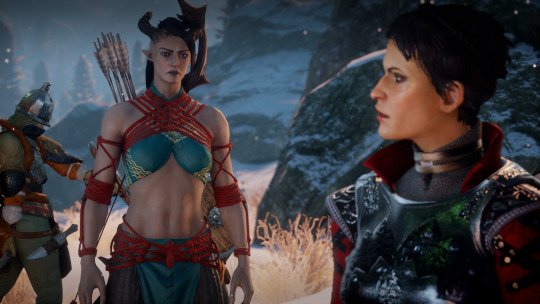
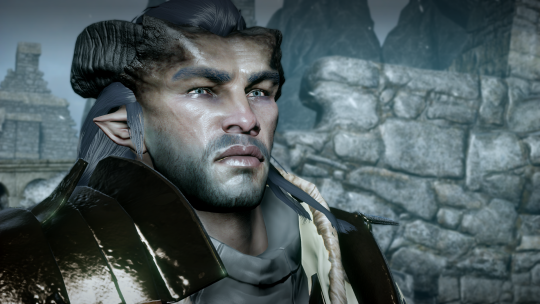
Female Qunaris having smaller horns is still one of the most offensive things Bioware has ever done
I think what confuses me the most, is that if it actually does turn out to be that the reason qunari look the way they look is because of dragon influence… then why is it that while only female dragons grow to be giant sized high dragons, male qunari characters all have giant models while female qunari characters have basically the exact same model as a female human but taller? And of course, that includes their horns.
^Rasaan from Those Who Speak #1, first ever depiction of a female qunari, standing next to a male counterpart
qunari in DA2 were a scary foreign force of militant eastern enemies, and they looked very inhuman.
come da:i, qunari were a playable race and therefore had to be less evil-looking, so the difference in humanization between men and women shrunk;
that above comic iteration obviously depicted qunari back during their ‘scary monster people from the south/east’ days, and bioware suddenly found themselves needing to draw a qunari woman. and that’s the direction they took. she has none of the men’s gauntness in her facial structure, and her skintone is more beige.
tldr; bioware’s track of qunari humanization can be measured in both the sexualization of women, and also the dehumanization of people of color.